
A Dramatic Drop in Crime
-
Proof of Principle: From the Rhode Island and Manila studies, it is obvious that the effect works in both Western and Non-Western cultures.
-
Adaptability: From the Jerusalem and Merseyside studies, we can see that the effect can influence both intense conflict zones and modern urban centres.
-
Local Relevance: The Merseyside study’s effect on a major metropolitan area shows exactly what we can anticipate in Adelaide.
1. The Metro Manila, Philippines Study (1984–1985)
-
The Study: A group of practitioners was established in Manila over two years.
-
The Result: Researchers found a significant decrease in crime (as well as a reduction in fatalities from various causes) that correlated exactly with the periods when the group size exceeded the square root of 1% of the population.
2. The Jerusalem ME Study (August–September 1983)
This study tracked a group of practitioners in Jerusalem to see if their presence could influence the intense conflict in neighboring Lebanon, as well as local crime.
-
The Study: Over a two-month period, the group size fluctuated. Researchers predicted that on days the group was large, violence and crime would drop, and on days it was small, they would rise.
-
The Result: The correlation was so precise it was described as a “light switch.” On days with large groups:
-
War deaths in Lebanon dropped by an average of 76%.
-
Crime in Jerusalem fell significantly.
-
Traffic accidents and fires also decreased.
-
-
The Maths: The probability that these fluctuations happened by chance was less than 1 in 10,000 ().
-
Publication: Journal of Conflict Resolution, Vol. 32, No. 4 (December 1988).
3. The 48-City Cross-Sectional Study (1973–1978)
If the Rhode Island study is about a single state, this study is about the broader macro-statistical trend.
-
The Study: Researchers analyzed 48 US cities of similar sizes. They compared cities where 1% of the population had learned meditation against “control cities” with similar demographics but no meditation groups.
-
The Result: In the 1% cities, crime rates decreased by an average of 16% compared to the control cities, which saw an increase in crime during the same period. This study helped establish the “1% Effect” as a mathematically predictable law of social physics.
-
Publication: U. S. Dept. of Justice – Office of Justice Programs
4. The Washington D.C., USA Project (June–July 1993)
While the 48-city study established the long-term “1% Effect,” this project was a high-intensity demonstration designed to prove that a coherence-generating group could reverse a violent crime trend in real-time, even in a “murder capital.”
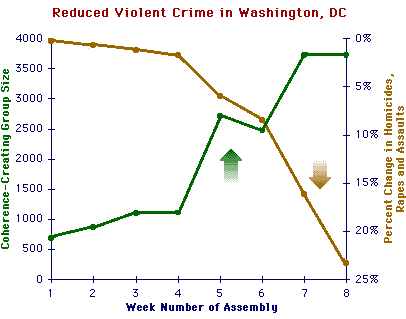
This graph shows that as the number of trained meditators increased in Washington, DC during the 1993 National Demonstration Project, the violent crime rate dropped significantly.
-
The Study: A group of up to 4,000 practitioners assembled in Washington D.C., USA for eight weeks. Before the study began, a 27-member independent Review Board (including sociologists and D.C. Police Department officials) approved the research protocol. The Board predicted that the group would reduce violent crime by 20%—a claim the D.C. Police Chief famously ridiculed at the time, stating it would take “two feet of snow” to achieve such a drop.
-
The Result: At the beginning of the experiment, about 600 meditators participated. By the end, over 4,000 meditators were involved, and violent crime was reduced by up to 23%. Despite a record-breaking heatwave, homicide, rape, and assault crimes dropped by 23.3% relative to the predicted trend by the end of the project. The correlation between the group size and the crime decrease was so precise that the probability of the result occurring by chance was less than 1 in 2 billion (p < .000000002).
-
Publication: Global Union of Scientists for Peace
The studies presented above are a representative sample of over 600 peer-reviewed papers.
SA Impact: These specific case studies provide a clear window into the 12% to 23% reduction in crime we can anticipate when the project is fully implemented in our state.
Based on approximately 200,000 annual offences in South Australia, a results-based reduction of this scale would mean between 24,000 and 46,600 fewer crimes per year.
Source: Calculated from the South Australia Police (SAPOL) Rolling Crime Statistics and the ABS Recorded Crime data (2023-2025).
Summary of Peer-Reviewed Research References
This list references the most rigorous, peer-reviewed, Field Effect studies that specifically measure the societal impact.
- Journal of Conflict Resolution (1988): The Abelon, et al. study. This is the “Gold Standard” for the field effect, demonstrating a 71% reduction in war deaths and a significant increase in cooperation during the Lebanon war when a coherence group was present.
- Social Indicators Research (1999): Hagelin, et al. This study tracked a 2,500-person coherence group in Washington, D.C. over 8 weeks. It showed a 23.3% decrease in violent crime, verified by an independent board of 27 sociologists and criminologists.
- The Journal of Mind and Behavior (1987): Dillbeck, et al. This longitudinal study analyzed crime rates in 160 U.S. cities. It found that cities reaching the “1% threshold” saw a significant and sustained decrease in crime compared to control cities.
- Journal of Crime and Justice (1981): Dillbeck, et al. This was the first major study to demonstrate the “1% effect” in 24 U.S. cities, showing a significant shift in crime trends once the threshold was met.