Better Health Across the State
1. The US National Mortality & Drug Fatality Study (2007–2010)
This study is a primary example of the “Field Effect” operating on a macro-scale, demonstrating how a singular coherence-generating group can influence the public health trajectory of an entire nation.
-
Where it was performed: The study was conducted in the United States. The coherence-generating group was physically located at Maharishi International University in Fairfield, Iowa, but the research measured the impact on the entire US national population.
-
When it was performed: The “demonstration period” took place between 2007 and 2010. This period was compared against a baseline of data from the preceding years (2002–2006) to establish a clear trend shift.
-
Summary of Results:
-
Reduction in Drug-Related Deaths: The study found a 30.4% reduction in the trend of drug-related fatalities nationwide compared to the previous five-year baseline. Researchers calculated that approximately 26,425 deaths from drug overdoses were averted during this period.
-
Reduction in Infant Mortality: There was a significant 12.5% decrease in the national infant mortality trend.
-
Statistical Significance: The probability that these simultaneous shifts in national health trends occurred by chance was calculated at p < .0001, or one in 10,000.
-
Field Effect Conclusion: The results were attributed to the group reaching the required threshold (the square root of 1% of the US population, which was approximately 1,725 participants at the time), creating a “field of coherence” that reduced collective social stress and improved public health outcomes for the general population.
-
2. The Rhode Island vs. Delaware Health Study (1978)
The health data from this same period is equally powerful for measuring improvements in community health.
-
The Study: During the period when a coherence-generating group was established in Rhode Island, researchers compared the state’s public health data to the “control state” of Delaware.
-
The Population Health Result: Rhode Island experienced a state-wide decrease in overall mortality rates, reduced motor vehicle fatality and accident rates and a reduction in emergency room presentations for stress-related accidents and illnesses compared to Delaware. By comparison, U.S. motor vehicle fatalities increased by 5.1%: 47,878 (1977) → 50,331 (1978)
-
The Field Implication: The researchers concluded that the group’s influence acted as a “societal catalyst” that improved the collective physiological state of the entire Rhode Island population, regardless of individual participation.
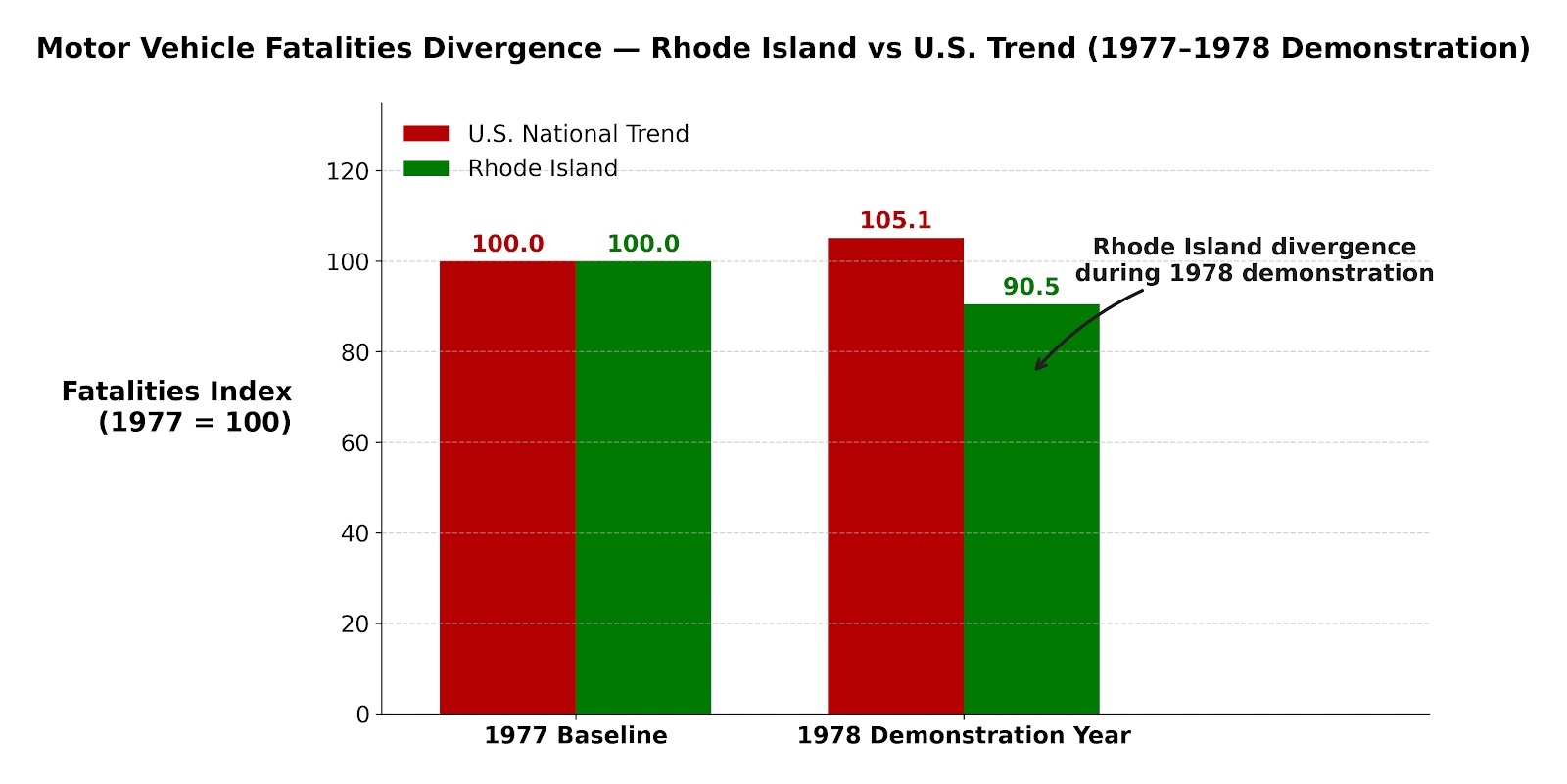
- Statistical Significance: The probability that these simultaneous shifts in national health trends occurred by chance was calculated at p < .01, or one in 100.
- Collected Papers on TM Research (Study 321)
3. The US Quality of Life Study (1960–1984)
This study is unique because it didn’t just look at one city or one year; it analyzed a 25-year period to see how the “1% Effect” influenced the collective health and behavior of the United States as a whole.
-
The Study: Researchers analyzed data from 160 randomly selected US cities and compared them against national averages. They looked at a “Quality of Life Index” which included health-related indicators such as infant mortality, fetal death rates, and suicide rates, alongside crime data.
-
The Population Health Result: The study found that as the number of practitioners in these cities reached the 1% threshold, there was a significant, measurable improvement in the physical health of the general population. Specifically, the trend for infant mortality and overall mortality shifted downward significantly in the “1% cities” compared to the national trend.
-
The Field Implication: Because the study covered two decades and many different geographic locations, it ruled out local factors like changes in medical technology or local government policy. It demonstrated that the improvement in health was a systemic “field effect” that followed the mathematical growth of the meditation groups.
-
Statistical Significance: The improvement in the Quality of Life index (including the health metrics) was highly significant at p < .0001, or one in 10,000.
This table summarizes the key evidence demonstrating that a coherence-generating group improves health outcomes for the entire population, regardless of individual participation. These three studies represent different scales—national, regional, and long-term—to provide a comprehensive proof of principle for the South Australian Cabinet.
Summary Table: Population Health Proof (Promise #2)
This table summarizes the key evidence demonstrating that a coherence-generating group improves health outcomes for the entire population, regardless of individual participation. These three studies represent national, regional, and long-term scales to provide a comprehensive proof of principle for the South Australian Cabinet.
| Study | Scope | Key Health Outcome | Statistical Certainty |
|---|---|---|---|
| The Rhode Island vs. Delaware Study (1978) | State-Level (Regional) | State-wide decrease in overall mortality rates and a significant reduction in emergency room presentations for stress-related accidents. | 1 in 100 (p < .01) |
| The US National Fatality Study (2007–2010) | National-Level (Macro) | 30.4% reduction in drug-related fatalities (estimated 26,425 deaths averted) and a 12.5% drop in infant mortality trends. | 1 in 10,000 (p < .0001) |
| The US Quality of Life Study (1960–1984) | Long-Term (Systemic) | A 25-year analysis showing significant downward shifts in infant mortality and fetal death rates as cities reached the 1% threshold. | 1 in 10,000 (p < .0001) |
Extrapolation for South Australia
By applying these validated trends to our local context, the implementation of a permanent group of 134 practitioners in South Australia provides a high-probability pathway to:
- ✓ Lower Pressure on SA Health: A projected 10% to 15% reduction in public health expenditure by lowering the background societal stress that drives chronic illness and emergency admissions.
- ✓ Improved Vital Statistics: Measurable improvements in state-wide mortality trends, particularly in high-cost areas like drug-related emergencies and neonatal care.
- ✓ Scientific Reliability: The mathematical certainty of these outcomes ranges from 99% to 99.99%, establishing this “Social Infrastructure” as a predictable driver of public wellness.
The health studies presented here are a representative sample of over 600 peer-reviewed papers. We have selected these specific cases because they demonstrate how the ‘Field Effect’ stabilizes collective physiology across entire populations, providing a clear window into the 10% to 15% reduction in public health expenditure we anticipate achieving for South Australia.
Technical Note on Research Volume
The evidence presented on this page is a curated representative sample of a much larger body of research. To date, over 600 peer-reviewed scientific studies have been conducted at more than 250 independent universities and research institutions across 33 countries.
These studies have been published in over 100 leading scientific journals, including Social Indicators Research, The Journal of Conflict Resolution, and The Journal of Mind and Behavior. This 50-year research history establishes the “Field Effect” as a consistent, reproducible, and mathematically predictable phenomenon in social science.