The Economic Logic: Prevention is Better than Cure, and Cheaper too.
Like all responsible jurisdictions, South Australia allocates significant resources toward managing the societal impact of stress, including the high costs of healthcare, policing, and correctional services.
The SA Peace Project represents a transition from this demand-driven maintenance model to a proactive “social infrastructure” strategy.
By addressing collective stress at its root, our state can generate a significant “Peace Dividend”—reclaiming funds currently dedicated to managing the aftermath of social instability.
The coherence threshold for South Australia is √1% of the South Australian population (134), plus a robust 90-person safety margin to ensure the effect is sustained 24/7.
134 people will deliver a measurable effect.
However, we propose a pool of 230 professionals with 200 practitioners rostered on for every session, morning and evening, 7 days a week.
This will ensure that we deliver substantial improvements in the parameters we measure, whilst maintaining a healthy safety margin that allows for absences within the team.
The following economic projections are extrapolated directly from our state-specific impact analysis: the tables below illustrate what we can expect from various levels of efficacy of the project. The budget is optimised for a regional hub like Mt Barker to minimise overhead while maximising environmental suitability.
Costs
Establishment
| Category | Description | One-Time Cost |
|---|---|---|
| Professional Training & Phase-In | Comprehensive professional development for 230 staff members ($15,000 per head), spread of 18 months. | $3,450,000 |
| Infrastructure & Admin Setup | Initial lease security in Mt Barker, utility establishment, and HR system integration | $750,000 |
| TOTAL INITIAL ESTABLISHMENT COST | $4,200,000 | |
Maintenance
| Operational Category | Calculation Methodology | Annual Cost |
|---|---|---|
| Professional Stipends | 200 rostered practitioners × $60/hr × 4.33 hrs/day × 365 days | $18,965,400 |
| Independent Research Audits | Ongoing third-party data verification and societal impact reporting | $300,000 |
| Operational Admin & Logistics | Ongoing lease, utilities, and core project management | $450,000 |
| TOTAL ONGOING MAINTENANCE BUDGET | $19,715,400 | |
Benefits
Public Safety & Justice (SAPOL, Courts, and Corrections)
This table illustrates the reduction in the cost of processing the state’s 200,000 annual offences, applying the system-wide unit cost of approximately $9,350 per crime.
| Efficacy Level of Project | ||||
|---|---|---|---|---|
| Category | Current – Approx. | 5% (Conservative) | 10% (Moderate) | 20% (Target) |
| Number of Crimes per year | 200,000 | 190,000 | 180,000 | 160,000 |
| Cost to the State | $1.87 Billion | $1.77 Billion | $1.68 Billion | $1.49 Billion |
| Savings | $93.5 Million | $187 Million | $374 Million | |
Public Health (Emergency & Stress-Related Care)
This table shows the reduction in the cost of attending to our state’s 1 million emergency health presentations, applying the state-wide cost of approximately $9,700 per treatment.
| Efficacy Level of Project | ||||
|---|---|---|---|---|
| Category | Current – Approx. | 5% (Conservative) | 10% (Moderate) | 20% (Target) |
| Number of Hospital Presentations per year | 1,000,000 | 950,000 | 900,000 | 800,000 |
| Cost to the State | $9.70 Billion | $9.21 Billion | $8.73 Billion | $7.76 Billion |
| Savings | $485 Million | $970 Million | $1.94 Billion | |
The Peace Dividend
This table combines the projected fiscal impact across both the justice and health systems to show the total effect of the Peace Project.
The “Dividend” is the net surplus remaining after the $19.7 million operational investment is subtracted from the total savings in Justice and Health.
| Efficacy Level of Project | ||||
|---|---|---|---|---|
| Category | Current – Approx. | 5% (Conservative) | 10% (Moderate) | 20% (Target) |
| Combined Justice and Health Cost | $11.57 Billion | $10.98 Billion | $10.41 Billion | $9.25 Billion |
| Savings | $578.5 Million | $1.157 Billion | $2.314 Billion | |
| Return On Investment | 2,934% | 5,868% | 11,737% | |
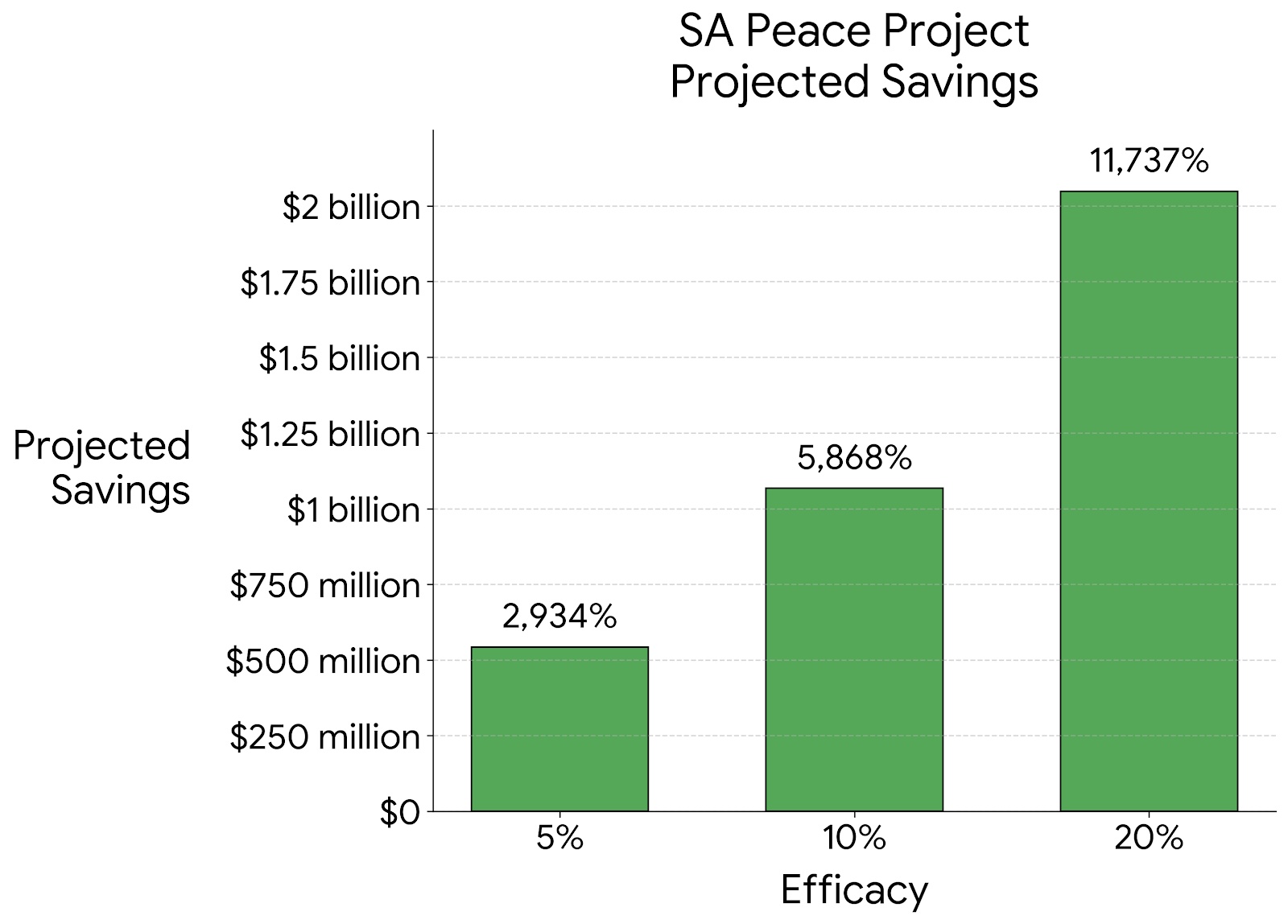
Because the budgeted expenditure for the Health and Justice sectors is so large ($11.57 Billion), even the most conservative efficacy rates of this project generate a return that fully self-funds the project’s maintenance and training.